
Grand Capital
Grand Capital Review: Offshore Registration, Bonus Traps, and Real Trader Reviews
Grand Capital review — this is the query that every potential client types into a search engine when they want to learn the truth about this broker, which has been operating since 2006. At first glance, the company looks solid: a long history, a modern platform, and plenty of bonuses and promotions. However, upon closer analysis, especially regarding regulation and legal status, the picture becomes less rosy.
In this article, we will conduct the most complete and objective analysis of the Grand Capital broker. We will discuss what the company’s registration on offshore islands actually means for the client, and what kind (or rather, what lack) of protection it provides. We will break down the bonus system in detail, the conditions for wagering these bonuses, and explain why they can lead to financial losses. And, of course, we will turn to the most honest source — reviews from real clients on the internet — to identify all the disadvantages and pitfalls of working with this broker.
Allure and Reality
Grand Capital positions itself as an international brokerage company providing access to trading on the Forex market, CFDs, stocks, and cryptocurrencies. The website is translated into many languages, and marketing materials are filled with promises of high profits and favorable conditions. But behind the attractive facade lies a legal structure, typical of thousands of companies in this market, which puts the client in a deliberately vulnerable position.
Grand Capital review. Offshore Registration: What Does It Mean for the Client?
This is the most important point from which any Grand Capital review should begin. The company’s legal “domicile” directly determines the level of your protection as an investor.
According to information on the official website in the regulation section, in 2024 Grand Capital received a license from the Mwali International Services Authority (MISA), located in the Union of Comoros.
Let’s break down what this means in practice.
What is the MISA License (Comoros)?
For the average trader, the phrase “license from an international financial regulator” sounds weighty. But in the world of Forex and CFDs, it’s not just the “piece of paper” that matters, but the jurisdiction that issued it.
Offshore Jurisdiction
The Comoros Islands are a classic offshore zone. The MISA regulator is not an independent and influential body like the FCA (UK), CySEC (Cyprus), or BaFin (Germany). The requirements for capital, reporting, and procedures for companies here are minimal.
Low Entry Barrier
Obtaining such a license is essentially buying the right to call oneself a “regulated company” for a small fee. This allows the broker to create an appearance of legitimacy without incurring serious obligations to clients.
Lack of Real Oversight
MISA does not have the resources or the inclination to thoroughly supervise the activities of licensees. If a client has problems with withdrawing funds or faces manipulation by the broker, there is effectively no one to complain to. Local laws do not provide the consumer protection we are accustomed to in Europe or other developed countries.
Grand Capital review. Minimum Company Registration Requirements
The very process of registering a company in an offshore zone (often in the Seychelles, BVI, or Marshall Islands) is extremely simple and cheap. It does not require having a multi-million dollar authorized capital, conducting complex audits, or proving good faith. This means that behind the Grand Capital brand, there could be a structure with minimal assets, and all risks effectively fall on the client.
FinaCom and Category A: Insurance or Marketing?
On the regulation page, Grand Capital also states that since 2016 it has been a member of the Financial Commission (FinaCom) and holds the highest reliability category “A”. Clients are promised compensation of up to €20,000 from the compensation fund.
This looks encouraging, but it’s important to understand the nuances:
FinaCom is NOT a regulator
It is a private, self-regulatory organization (service provider), created by market participants themselves. It does not possess governmental authority. Its decisions are recommendatory for the broker, and it cannot force them to pay compensation.
The Compensation Fund
Yes, it exists, but the procedure for obtaining compensation is far from simple. It is initiated only after the Commission reviews the dispute and rules in the client’s favor. If the broker refuses to comply with the decision, the client must independently seek payment from this fund, which in practice can take months and require significant effort.
Category “A”
This category is assigned by the Financial Commission itself. Essentially, it’s a marketing label that has nothing to do with financial stability verified by an independent government body.
Section Summary: Grand Capital operates under a classic offshore scheme. The possession of an MISA license is merely a formality, providing no real guarantees to clients. Membership in FinaCom is a useful but limited tool for pre-dispute resolution, not insurance against all risks. Legally, in case of a conflict, the client is left alone with a company registered in a jurisdiction with very peculiar laws.
Grand Capital review. Promotions and Bonuses: Generosity That Comes at a High Cost
Grand Capital, like many offshore brokers, is known for its aggressive bonus policy. The website features numerous offers: a first deposit bonus (up to 100% or more), cashback, no-deposit bonuses for registration, bonuses for replenishing an account, and so on. They look very tempting, but behind each such “freebie” lie strict conditions that make withdrawing your own funds extremely difficult.
Grand Capital review. How Do Bonuses Work? The Illusion of “Free Money”
Imagine you funded your account with $100, and the broker gave you a 100% bonus — another $100. Your balance shows a nice sum of $200. Great, your capital has doubled! But that’s only at first glance. In reality, that $100 is not your money. It’s credit funds that the broker lends you for trading, and you cannot simply withdraw them.
In your personal account, funds are usually divided into two categories:
- Real Credit: This is your own deposit.
- Bonus Credit: These are the broker’s “virtual” funds.
You can trade using the total amount, but when withdrawing funds or incurring losses, the bonus part is the first to be “burned” or deducted.
Grand Capital review. Bonus Wagering Requirements: An Impossible Mission?
The main catch lies in the bonus wagering (turnover) requirements. To convert the bonus funds into real money and be able to withdraw them, the client must generate a trading turnover many times greater than the bonus amount.
Typical conditions for Grand Capital look like this (always check the current rules on the website):
- To wager a 100% deposit bonus, you need to execute trades with a total volume (lot size) 40-50 times the bonus amount.
- Only closed trades are counted.
- There is a limited time to complete the wagering (e.g., 30 or 90 days).
Mathematical Example
You received a $100 bonus. To wager it, you need to trade a volume of $100 * 50 = $5,000 (or 50 mini-lots). This means you’ll have to open and close numerous positions, essentially “churning” money, just to fulfill the condition. During these manipulations, you will very likely:
- Incur spreads and commissions that eat into part of your deposit.
- Make a losing trade, as the market is unpredictable, and the chase for volume pushes you towards reckless risks.
Ultimately, the broker’s goal is to make you trade as much as possible. The more you trade (even “breaking even”), the more the broker earns from commissions. If, after receiving a bonus, you fail to meet the wagering requirements and try to withdraw only your $100, the bonus is canceled, and often any profits made using it may also be deducted.
Grand Capital review. No-Deposit Bonuses: A Trap for Beginners
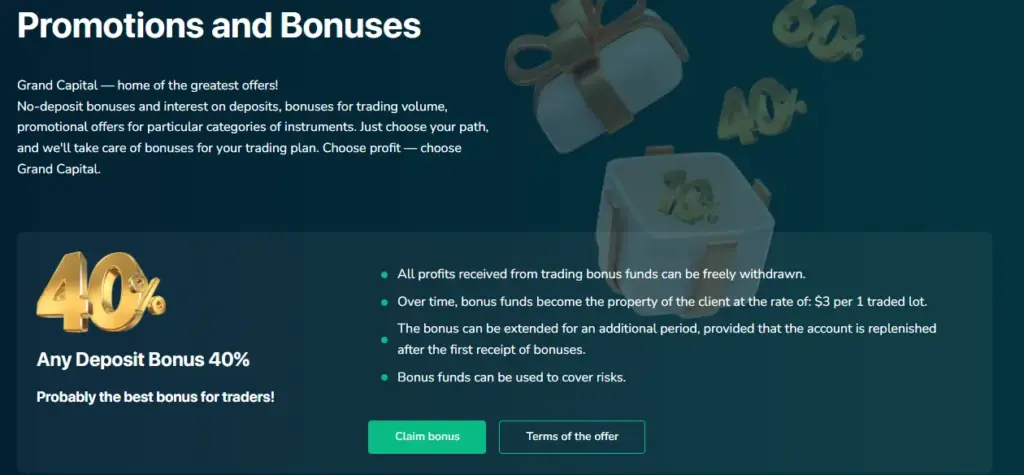
A special case is no-deposit bonuses (e.g., $50 for registration). This is the most effective marketing hook.
Enticement
A newcomer registers, receives “free” $50 in their account, and starts trading.
Illusion of Easy Money
They might even get lucky and increase the account to $200-300.
Impossibility of Withdrawal
But then a problem arises. The conditions for withdrawing funds from a no-deposit bonus are even stricter. Usually, it requires not only wagering the bonus with a huge turnover (100 times or more) but also making a first personal deposit (e.g., $50-$100). Only after fulfilling these conditions can you submit a withdrawal request.
The Outcome
To withdraw what they think is their $200, the trader deposits $100, starts trading frantically to meet the unrealistic volume targets, and most likely ends up losing both the bonus and their own hard-earned money. The broker gains a new client who has already made a deposit and is actively trading.
Section Summary: Grand Capital’s bonuses are not a gift but a tool to retain clients and encourage them to make an excessive number of trades. The wagering conditions are designed to make withdrawing funds as difficult as possible. For a disciplined trader who wants to preserve their capital, accepting such bonuses is strongly not recommended.
Client Reviews Online: What Are They Saying on Forums?
When searching for Grand Capital review on independent platforms (forums, review sites), a contradictory picture emerges, but one predominantly dominated by negativity. Positive reviews are often left by traders who either haven’t faced problems withdrawing larger sums or are partners (agents) of the broker, interested in attracting clients. Negative reviews, on the other hand, share several typical problems.
Grand Capital review. Typical Problems with Withdrawing Funds
This is the most “hot-button” issue. Clients complain about:
Sudden Verifications
A withdrawal request may be blocked, requiring them to provide a photo with a passport, bank statements, address proof, wallet screenshots, and even a photo of the account holder with the request number displayed on a computer screen. This is the broker’s legal right to combat fraud, but often the procedure is deliberately delayed so the client will “churn” an even larger volume of trades or simply give up.
Withdrawal Cancellation
After passing verification and the request being approved, the withdrawal may be canceled by the security department without explanation. The verdict often includes a vague phrase like “violation of the terms of the user agreement.” Which specific violation is not clarified.
Maximum Amount Limits
The rules may specify a maximum withdrawal amount per month or per transaction, which becomes a serious obstacle for large traders.
Return of Deposit, Not Profit
In some cases, when withdrawing funds, clients are only returned their initial deposit amount, with all profits canceled, citing the bonus rules or other clauses of the agreement.
Grand Capital review. Slippage and Requotes
Traders who trade news events or use Expert Advisors often complain about the quality of order execution. During periods of high volatility, the following are observed:
- Slippage: An order is opened or closed at a price significantly worse than requested.
- Requotes: The terminal reports a price change and offers to agree to the new price or cancel the order. This leads to missed profits or increased losses.
Although the broker explains this by market conditions, many clients suspect manipulation by the trading server (the so-called “dealing desk” or “kitchen”), especially when it comes to withdrawing large profits.
Grand Capital review. Technical Support Performance
Support at Grand Capital exists, but its effectiveness often draws criticism.
Template Responses
Complex questions, especially those concerning withdrawal refusals, receive formal replies referring to the user agreement.
Slow Problem Resolution
Issues requiring intervention from technical specialists or the finance department can take weeks to resolve.
Ignoring
Some users complain that after moving the conversation to official correspondence (e.g., via email), their inquiries are simply ignored.
Disadvantages of Working with Grand Capital Broker: Summary
Summarizing our Grand Capital review, we can highlight the following key disadvantages that everyone considering cooperation with this company should know:
Offshore Status and Lack of Serious Regulation
The MISA license from the Comoros Islands provides clients with no legal guarantees whatsoever. In case of a serious conflict, you would have to defend your rights in a court of an offshore jurisdiction, which is practically impossible and prohibitively expensive. This is a fundamental drawback that outweighs many potential pros.
Marketing Nature of the “Reliability Category”
Membership in FinaCom is not a substitute for government regulation, but merely a tool for pre-trial dispute resolution, the effectiveness of which is limited.
Oppressive Bonus Program Conditions
Bonuses at Grand Capital are a credit trap. The wagering conditions (huge required turnover) almost guarantee a loss of time and money for an inexperienced trader. They are aimed not at helping the client, but at encouraging them to trade non-stop, generating income for the broker.
Risks When Withdrawing Funds
This is the most critical drawback, evident from the reviews. Problems with withdrawals (delays, excessive verification, payment cancellations) are a systemic issue for many offshore brokers, and Grand Capital is no exception.
Lack of Transparency in Trading Conditions
Complaints about slippage and requotes cast doubt on the fairness of order execution, especially when it comes to profitable client trades.
Conflict of Interest
As a market maker (dealing desk), Grand Capital profits from its clients’ losses. This creates a fundamental conflict of interest that does not foster fair and transparent trading conditions for the trader.
Grand Capital review. Conclusion
Grand Capital is a typical representative of a huge number of offshore forex brokers. It has its own set of pluses: a long operating history, convenient platforms, a wide range of trading instruments, and multilingual support. All these advantages are negated by the main drawback — the lack of a reliable regulator and the associated risks.
Registration in the Comoros Islands and membership in the private FinaCom cannot guarantee the safety of your funds in the way that working with a broker licensed by the FCA, CySEC, or BaFin can. The company’s bonus policy is aggressive and designed to tie the client to the account and force them to take actions that are disadvantageous to themselves. And the numerous negative reviews about problems withdrawing funds confirm that the risks here are not theoretical, but very real.
If you still decide to open an account with Grand Capital, do so with a full understanding of all the risks:
- Never view bonuses as a gift. Consider them a burden.
- Do not keep amounts in the account that are precious to you or that you are not prepared to lose.
- Withdrawing large profits could become a serious challenge.
The search for Grand Capital review was meant to lead you to this truth. The choice, as always, is yours, but there are brokers on the market with more transparent and safer operating conditions, who respect their clients and their money.
Check the ratings and reviews of brokers on the page. Also read the articles in the News section.
More information about forex brokers’ affiliate programs is available on the website.
Please sign in to your account to leave a review